Combi Boiler Installation in Southampton
Combi boiler installation is the most common conversion we carry out in Southampton, and the one most often sold to people it does not suit. Moving from a regular or system boiler to a combi frees up the airing cupboard and the loft, removes two water tanks and gives unlimited hot water on demand. It also makes your hot water entirely dependent on the mains supply reaching your house, which in parts of the city is the weak link. We test that before quoting rather than after fitting.
What a Combi Conversion Actually Involves
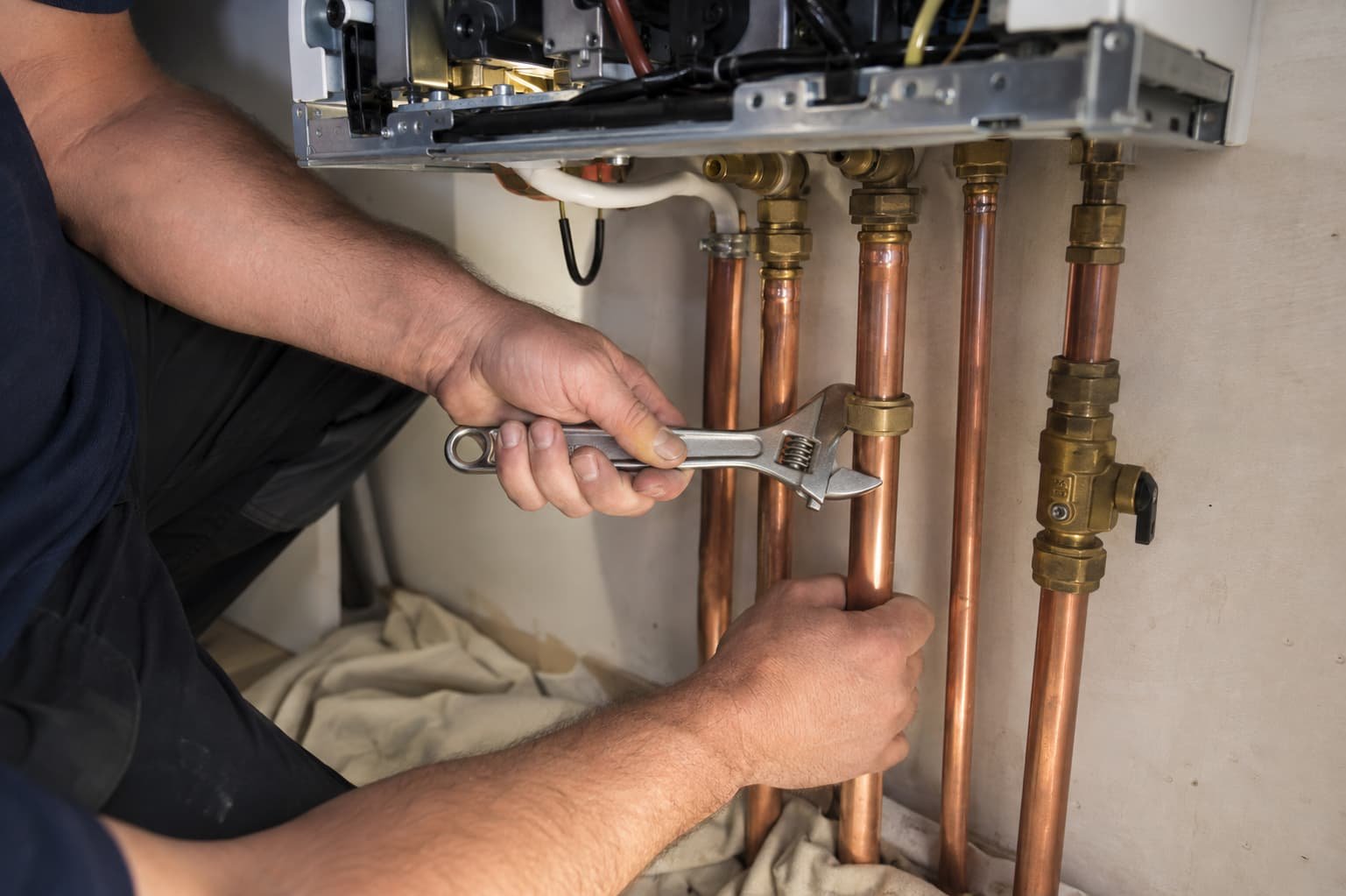
A conversion is a bigger job than a swap. The hot water cylinder comes out of the airing cupboard, the cold feed and expansion tanks come out of the loft, and the pipework that fed them is capped or removed. The system becomes sealed and pressurised, so it needs an expansion vessel, a filling loop and a pressure relief discharge to outside. The gas supply is checked along its whole length, because a combi draws considerably more gas than the regular boiler it replaces and an undersized run that coped for twenty years will not cope now.
What you gain is space and simplicity. What you give up is stored hot water, which means two showers running at once will fight each other in a way they did not with a cylinder. In a three-bathroom house in Bitterne Park or a converted property off Highfield Lane, that trade is often the wrong one, and we will tell you so before you have spent anything.
Flow Rate Decides This, Not Bathroom Count
The number that matters is how many litres a minute your incoming main can actually deliver. Below roughly 10 litres a minute a combi will disappoint no matter which model goes on the wall. Between 10 and 15 it works well for most households. Above 15 it performs strongly and larger output units become worthwhile.
You can check it yourself in two minutes. Run the cold kitchen tap fully open into a measuring jug for ten seconds, then multiply what you collect by six. That gives litres per minute. Older properties in the city centre and the inner suburbs sometimes still have a small-bore or partly lead service pipe from the main, and those are the ones that measure low. Where the result is marginal, upgrading the service pipe can be the better spend, and occasionally a system boiler with an unvented cylinder is the honest answer instead.
Hard Water and the Plate Heat Exchanger
Southampton water comes off the Hampshire chalk at roughly 240 to 280 parts per million of calcium carbonate. In a combi, mains water passes through a plate heat exchanger every time a tap opens, and that component scales faster than anything else in the system. The symptoms arrive gradually: hot water that runs lukewarm at first, then takes longer to arrive, then fluctuates in temperature while the shower is running.
Every combi we fit in the city gets a scale reducer on the incoming main and a magnetic filter on the heating return. Together they cost a fraction of a replacement heat exchanger, and they are the single clearest difference between a combi that is still performing properly at year ten and one that is being nursed along at year six.
Combi Boiler Installation Prices
- Combi swap, like for like — from £2,100 to £3,200
- Conventional or regular system converted to combi — from £3,200 to £4,600
- Back boiler removed and combi fitted — from £3,600 to £5,200
- Scale reducer and magnetic filter, fitted with the boiler — from £220 to £380
- Gas supply upgrade where the existing run is undersized — from £300 to £700
Fitted and commissioned, old appliance removed. A conversion normally takes two days rather than one, because tank removal, capping and making good the cupboard all take time that a straight swap does not.
Sizing, and Why Bigger Is Usually Worse
A combi that is too powerful for the property short-cycles: it fires, satisfies the demand almost immediately, shuts down, then repeats. That wears components and wastes gas. Under Part L the heating side should be sized on a room-by-room heat loss calculation for a maximum flow temperature of 55°C where practicable, and the boiler should modulate down to the actual heating load of the house. Hot water demand sets the upper output, heating demand sets the lower, and the right unit satisfies both. Guidance on correct sizing and low-temperature operation is published by the Heating and Hotwater Industry Council.
Questions We Are Asked Before a Conversion
Can I keep my airing cupboard? Yes, you keep the cupboard, you just lose the cylinder inside it. Most people fit shelving. Bear in mind it will no longer be a warm cupboard, which matters more to some households than they expect.
Do the loft tanks have to come out? They should. Leaving redundant tanks in place invites leaks from perished valves years later, and they are far easier to remove while the system is drained.
Will my radiators still work? Yes, though a sealed system runs at a set pressure and any radiator or joint that was weeping quietly under gravity will show itself. We pressure test before finishing so anything marginal is found on our time.
Is a combi suitable for a shared house? Often yes, and the simplicity helps, but sizing has to reflect real simultaneous demand rather than the number of bedrooms. See our boiler servicing and landlord CP12 page for the compliance side.
Where We Fit Combi Boilers
We cover Southampton and the surrounding towns, including Portswood, Woolston, Shirley, Bitterne and Eastleigh.
If your existing boiler is simply at the end of its life and the system suits you as it stands, our boiler replacement page covers the like-for-like route, and boiler installation sets out how we approach a job from scratch.
Send us the property details and what the current system is doing wrong, and we will tell you whether a combi is the right answer before we quote for one.