
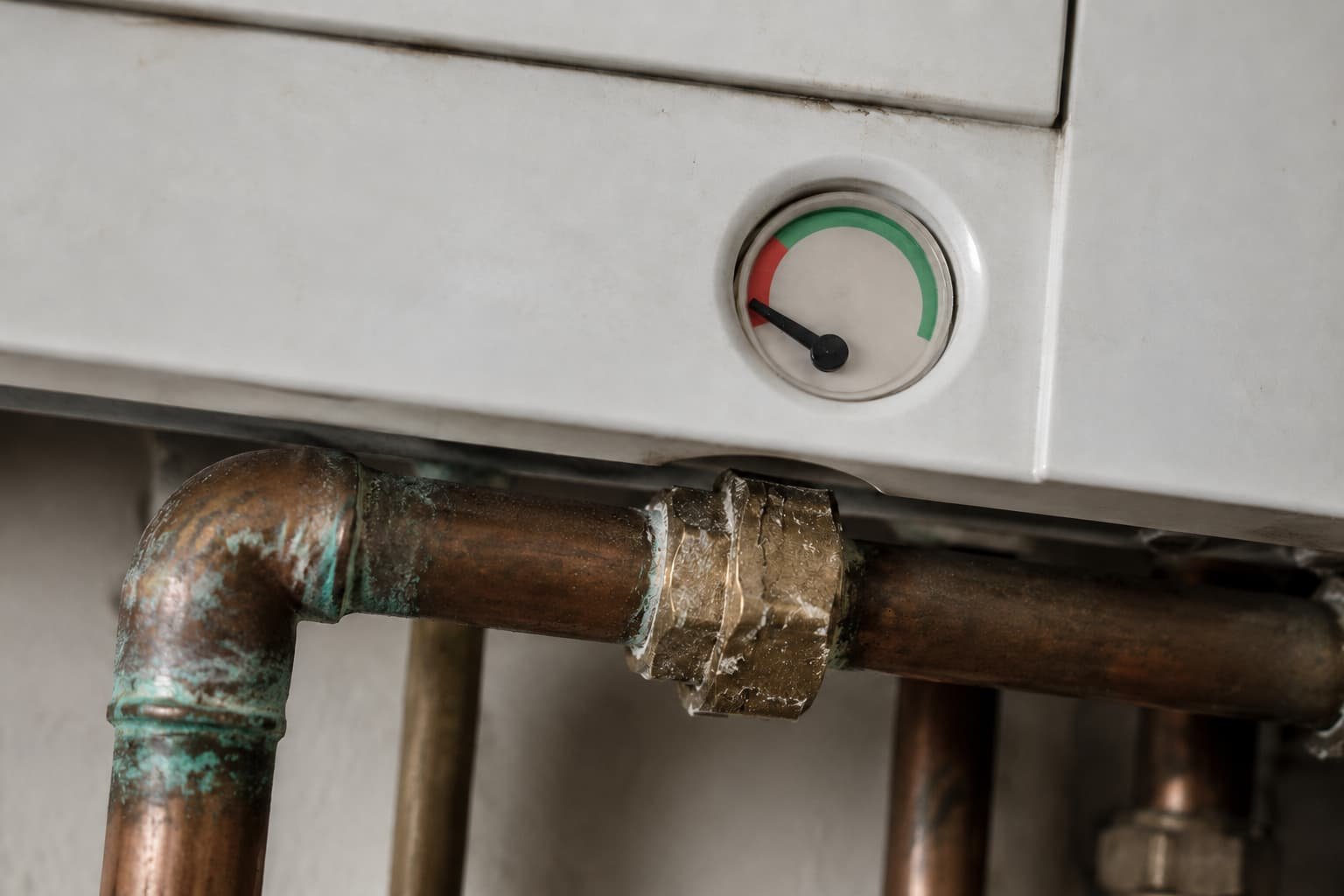
Boiler flow rate is the number that decides whether a combi will give you a strong shower or a weak one, and almost nobody measures it before buying one. You can check yours in two minutes with a jug and a watch, and the result tells you more about which boiler suits your house than any salesperson will. This guide explains what the number means, how to test it, and what to do with the answer.
What Boiler Flow Rate Actually Is
Boiler flow rate is simply how much water your plumbing can deliver in a given time, measured in litres per minute. It is set by your incoming mains supply and the pipework carrying it, not by the boiler. A combi heats water on demand as it passes through, so it can only ever hand you the water your mains gives it. Put a powerful combi on a weak supply and you get a weak shower from an expensive boiler.
This is the single most misunderstood point in choosing a combi. People assume a bigger or more expensive unit means more hot water. It does not. Above a certain point the boiler is waiting on the mains, and the extra output is doing nothing at all.
The Two-Minute Boiler Flow Rate Test
You need a measuring jug and a clock with a second hand. Do this at the kitchen cold tap, which is normally fed directly from the mains before it branches anywhere else.
- Turn the cold kitchen tap fully open.
- Hold the jug under it and collect water for exactly ten seconds.
- Measure how much you caught, in litres.
- Multiply by six. That is your flow rate in litres per minute.
If you caught two litres in ten seconds, your flow rate is twelve litres per minute. That is it. Do it two or three times and take the average, because a single reading can be thrown by a tap that is not fully open or a jug that overflowed.
Reading Your Result
Below 10 litres a minute. A combi will disappoint here regardless of which one you fit. The shower will be adequate at best and will weaken noticeably whenever another tap runs. Below this figure the honest options are to improve the supply or to choose a stored-hot-water system instead.
10 to 15 litres a minute. A combi works well for most households in this range. A single shower will be strong, though running a second hot outlet at the same time will still take the edge off it.
Above 15 litres a minute. A combi performs strongly, and higher-output models become worth the money because there is enough supply to feed them. Two outlets at once are more comfortable, though never quite as untroubled as stored hot water.
These bands are why we test boiler flow rate before quoting a combi rather than after fitting one. Selling someone a combi for a house that measures at nine litres a minute produces a disappointed customer and a boiler that was never going to satisfy them.
Why This Matters Especially in Southampton
Two local factors push in opposite directions and both are worth knowing.
The older inner suburbs and parts of the city centre still have properties on small-bore or partly lead service pipes running from the main to the house. These are the supplies that measure low. If your house is Victorian or Edwardian and has never had its incoming main upgraded, a low reading is common and often fixable by replacing that service pipe, which can transform the flow rate without touching the boiler.
The water itself is the other factor. Southampton is supplied from the Hampshire chalk at roughly 240 to 280 parts per million of calcium carbonate, which is hard. Scale narrows pipework and furs up the plate heat exchanger inside a combi over time, so a supply that measured fine when the boiler was new can drift downward over years of unprotected running. A weakening shower on an ageing combi is often scale rather than a failing boiler, which is why we fit a scale reducer and a magnetic filter as standard here. Independent advice on efficient hot water and heating is published by the Heating and Hotwater Industry Council.
What to Do If Your Reading Is Low
Check the stopcock is fully open. The simplest cause of all. Internal stopcocks get nudged partly closed and never reopened, throttling the whole house. Open it fully and retest before doing anything else.
Look at the service pipe. An old lead or narrow-bore supply from the main is the most common genuine restriction in this city’s older housing. Upgrading it is a job in its own right but can lift a marginal supply into the comfortable range.
Consider stored hot water. Where the supply genuinely cannot be improved, a system boiler with an unvented cylinder stores hot water at pressure and delivers a strong flow to several outlets at once, independent of what the mains can manage in real time. In a busy household with more than one bathroom this is frequently the better answer anyway.
Rule out scale. If the flow used to be fine and has weakened on an older combi, the plate heat exchanger may be scaling up. A power flush and descale, or in stubborn cases a replacement exchanger, restores it. Our boiler repair page covers this.
Using the Number When You Get Quotes
Take your boiler flow rate figure to every quote. It immediately separates the installers who ask about it from those who do not. An installer who specifies a combi without ever measuring your supply is guessing, and you are the one who lives with the guess.
If your reading sits below ten and someone still quotes you a large combi with a confident promise of powerful showers, be sceptical. The physics does not bend to a sales pitch. A good installer will either propose improving the supply or steer you toward stored hot water, and will explain why.
Getting It Measured Properly
The jug test is a reliable guide, and it is enough to tell whether you are comfortably in combi territory or not. At survey we measure it accurately, along with the dynamic pressure that a jug cannot show, and factor both into the recommendation.
See combi boiler installation for how flow rate feeds into choosing a combi, boiler installation for our approach to the work, and boiler replacement if you are weighing up whether to change system type at the same time.